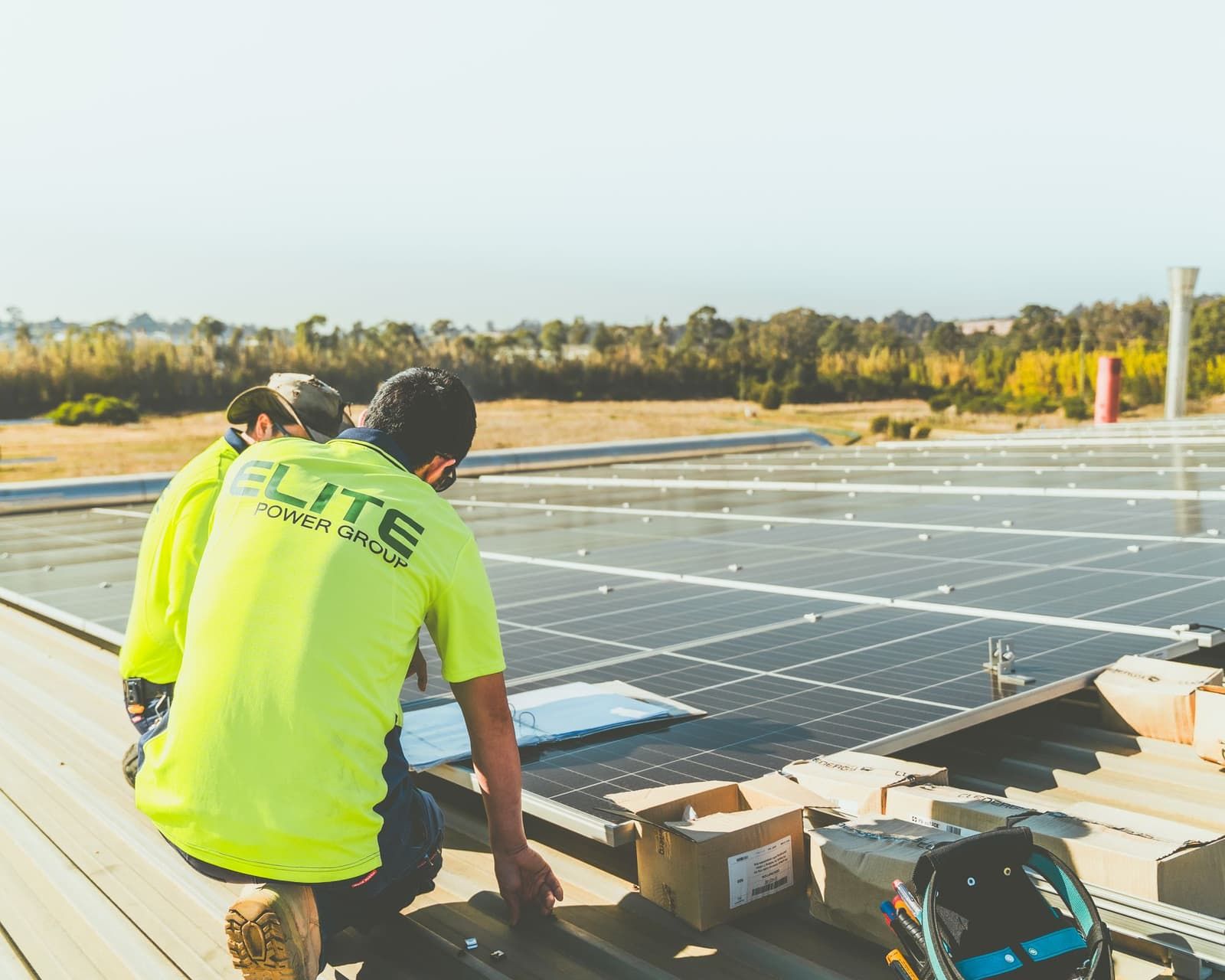
Most Australian small businesses pay for commercial solar with equipment finance, usually a chattel mortgage. The panels, inverter and battery are the security, the business owns them from day one, and repayments can sit alongside the savings on your power bill. Get the federal rebate taken off the quote first, then finance the rest. Timing matters too: the rebate on both panels and batteries steps down on 1 January 2027.
If your power bill has become one of your biggest overheads, you’re in good company. Cafés with cool rooms, workshops running compressors, bakeries firing ovens at 4am, warehouses with refrigeration: plenty of owners are asking the same thing right now. “Can I finance solar for my business, and is now the right time?” Here’s how to work it out, step by step.
Can you get finance for solar panels on a business?
Yes. Solar panels, inverters and batteries are physical business assets, so lenders treat them much like any other equipment. That opens up the usual equipment finance structures:
- Chattel mortgage. Your business buys the system and owns it straight away. The lender holds security over the equipment until it’s paid off. If you’re registered for GST, you can generally claim the GST in the purchase price on your next BAS.
- Finance lease. The lender owns the system and you pay to use it, with GST credits claimed on each payment instead of all at once.
- Hire purchase. Ownership passes to you with the final payment, and you’re generally treated as the owner for tax.
Our equipment finance page covers how each one works in more detail, and runs from $20k to $500k. For most small commercial systems, a chattel mortgage is the simplest fit, because owning the system keeps the tax side straightforward.
Because the equipment is the security, you don’t normally need to put your house on the line. That’s a big difference from a bank loan secured against property. Our guide to secured vs unsecured business loans explains why that matters.
How does the solar rebate work for businesses?
The federal rebate for solar comes from the Small-scale Renewable Energy Scheme, run by the Clean Energy Regulator. The scheme is designed for “homeowners and businesses”, so a small business qualifies on the same footing as a household.
Here’s the practical version:
- An accredited installer puts in an eligible system.
- The system creates small-scale technology certificates (STCs) based on how much power it’s expected to generate.
- You assign those certificates to the installer or a registered agent, and in return you get a discount off the price.
So the “rebate” usually shows up as a line on your quote, not a cheque in the mail. That’s good news for finance, because you only borrow the amount left after the discount.
Why does 1 January 2027 matter?
Because the scheme winds down every year until it ends in 2030. For solar panels, the number of certificates depends on a “deeming period”. According to the Clean Energy Regulator’s entitlement table, systems installed in 2026 get a five-year deeming period. Systems installed in 2027 get four.
That’s one fifth fewer certificates for the same system, just for installing a few weeks later. And it’s installation that counts, not the date you signed the quote. Installers get busy in the run-up to Christmas, so if you’re keen, sort the quote and finance in October or November.
Is there a battery rebate for small businesses?
Yes. The Cheaper Home Batteries Program sounds like it’s only for households, but the Clean Energy Regulator’s battery page says it supports “households and small businesses”. The key rules for a business:
- One battery per site. You can claim for one solar battery per national metering identifier (NMI) or commercial sub-meter.
- It needs solar. The battery must be installed with a solar system of no more than 100 kW, either new or existing.
- Size limits. Nominal capacity must be between 5 and 100 kWh, and certificates are only created for the first 50 kWh of usable capacity.
- Tapered support. The discount is aimed at around 30 per cent of the upfront cost, tapering for bigger batteries: full rate for the first 14 kWh, 60 per cent from 14 to 28 kWh, and 15 per cent from 28 to 50 kWh.
- It steps down too. The battery STC factor is 6.8 per kWh from May to December 2026, falling to 5.7 from January 2027 and lower again every six months after that.
A battery tends to make the most sense if you trade into the evening or run refrigeration overnight, because it stores your daytime solar for the hours when you’d otherwise be buying from the grid.
Thinking about putting panels or a battery on the roof before the rebate drops? See what your business could qualify for. It takes about 60 seconds and won’t affect your credit score.
What about bigger systems over 100 kW?
This is brand new. From 1 October 2026, the scheme was expanded to cover solar systems from 100 kW up to 1 MW, the kind of size you’d see on a factory, cold store or large warehouse roof. The Clean Energy Regulator’s mid-scale solar page explains that these systems can choose either:
- upfront STCs with a fixed five-year deeming period; or
- certificates under the new Renewable Electricity Guarantee of Origin scheme instead.
Applications for mid-scale certificates open in mid to late November 2026. If you run a manufacturing business or a big shed with a big daytime load, ask your installer which option suits you, and get the answer in writing before you lock in the finance.
Can you claim the instant asset write-off on solar?
Possibly, for some or all of the system. The ATO has confirmed the $20,000 instant asset write-off is here to stay from 1 July 2026 for small businesses with aggregated turnover under $10 million. The limit applies per asset, and the asset has to be first used or installed ready for use in the year you claim it.
Most commercial systems cost more than that, so the balance usually goes into the small business depreciation pool and is claimed over several years. How the panels, inverter and battery are split up for tax is a question for your accountant, not your installer. Our guide to equipment finance and the instant asset write-off explains how financed assets fit in. The short version: with a chattel mortgage your business is generally treated as the owner, which is what you need to claim depreciation.
How do you work out if solar finance stacks up?
Here’s a simple way to test it before you talk to anyone.
Step 1: Know your usage. Gather 12 months of power bills. Look at how much you use during daylight hours, because that’s what solar replaces most directly.
Step 2: Get comparable quotes. Ask two or three accredited installers for quotes that show the system size, the STC discount as its own line, any battery discount, the expected annual generation and the install date.
Step 3: Compare the monthly figures. Put the estimated monthly saving next to the estimated finance repayment. If the saving covers most or all of the repayment, the system is close to paying its own way while you own a growing asset.
Step 4: Test the quiet months. Winter generation is lower. Make sure the repayment still feels comfortable in June and July, not just January.
Step 5: Add the tax picture. Ask your accountant about depreciation and the GST credit, which can give your cash flow a boost in the BAS after installation.
Worked example: illustrative only. A family-run bakery in regional Victoria uses a lot of power early in the morning and through the day. The owners get three quotes in October 2026 and pick a mid-sized rooftop system with a 13 kWh battery for evening fridge loads. The quote shows the STC discounts as separate lines, which brings the price down by a noticeable amount.
What they checked What they found Install date Booked for late November, well before 1 January 2027 Rebate Five-year deeming period for the panels and the 2026 battery factor locked in Funding Chattel mortgage over the system, no property security Monthly test Estimated savings cover most of the repayment, even in winter Tax GST credit claimed on the next BAS; depreciation discussed with their accountant If the same system were installed in February 2027 instead, the bakery would get one fewer year of panel certificates and a lower battery factor. Same roof, same panels, smaller discount.
What will a lender want to see?
Solar finance is assessed much like any equipment purchase. Have these ready and things move quickly:
- The installer’s quote or invoice, showing the system details and the STC discount
- 3–6 months of business bank statements
- Photo ID and your ABN or ACN
- Landlord consent in writing, if you lease the premises
- Financial statements, but only if you’re borrowing over $150,000
If you lease, sort the landlord question early. You’ll want written agreement on who owns the system, whether you can take it with you, and what happens at the end of the lease. Lenders will ask, and it saves headaches later.
Not every solar project fits neatly into equipment finance. If you need to cover installation extras, roof repairs or switchboard upgrades as well, a small business loan can sit alongside the equipment finance for the bits that aren’t bolted to the roof.
Ready to put the sun to work? See if you qualify
Solar is one of those upgrades that can pay you back every single month, and right now the timing is on your side, with more rebate available before 1 January 2027 than after it. The thing that usually holds owners back isn’t the idea, it’s finding the cash for the upfront cost. That’s exactly what equipment finance is for, and it’s something we help everyday Australian businesses with all the time.
Here’s how it works with us:
- About 60 seconds to enquire, and no credit check when you first get in touch.
- We don’t spray your details around. Your enquiry isn’t sent off to a pile of lenders, so your phone won’t light up with strangers.
- A real person reviews your situation. We look at your trade, your quote and your timing, then call you to talk through options.
- Fill the form in accurately, please. Real turnover figures and the actual quote amount help us find the right fit the first time.
Decisions can come through in as little as 4 hours once your documents are in, and same-day funding is possible once you’re approved. Your installer can get you on their calendar sooner.
Ready when you are
Check your options in about 60 seconds
A few quick questions. Asking won't touch your credit file, your details aren't sent to a pile of lenders, and a real person reads every enquiry.
Your path to funds
This week
Pull 12 months of power bills and note your daytime usage
Next 2 weeks
Get two or three quotes with the STC discount shown as its own line
Same time
Run the numbers with your accountant: write-off, GST and repayments
Before December
Lock in finance and an install date before the 1 January rebate step-down
Questions we get asked
Can a small business get the solar rebate?
Yes. The Small-scale Renewable Energy Scheme is open to businesses as well as households. When you install an eligible system with an accredited installer, you can usually assign the certificates to the installer or a registered agent in return for an upfront discount on the price.
Can I finance solar panels with equipment finance?
Yes. Solar panels, inverters and batteries are tangible business assets, so they can generally be funded with a chattel mortgage, a finance lease or hire purchase. The equipment itself is usually the security, so you don't normally need to put property up.
Is the battery rebate available to businesses?
Yes. The Cheaper Home Batteries Program covers households and small businesses. You can claim one battery per national metering identifier or commercial sub-meter, it must be installed with a solar system of no more than 100 kW, and certificates are only created for the first 50 kWh of usable capacity.
Can I claim the instant asset write-off on a solar system?
Possibly. The $20,000 instant asset write-off is permanent from 1 July 2026 for small businesses with aggregated turnover under $10 million, and it applies per asset. Your accountant will work out how the components of your system are treated and whether any part falls under the limit. Larger amounts usually go into the small business pool instead.
Should I wait until next year to install solar?
Waiting usually costs you rebate. Solar panel systems installed in 2026 get a five-year deeming period and 2027 installs get four, and the battery STC factor drops from 6.8 to 5.7 per kWh on 1 January 2027. The system has to be installed, not just ordered, to count.
What's changed for bigger business solar systems?
From 1 October 2026, the scheme was expanded to cover solar systems between 100 kW and 1 MW. These mid-scale systems can choose upfront certificates with a fixed five-year deeming period, or certificates under the new guarantee of origin scheme instead. Applications for mid-scale certificates open in mid to late November 2026.
Do I need to own my building to finance solar?
Not always, but it makes things easier. If you lease, you'll need the landlord's written consent to install, and it's worth agreeing in writing who owns the system and what happens to it at the end of the lease. Lenders will ask.